More about Beecholme


Beecholme is also the first postwar "mixed development" housing scheme in Hackney, with a mixture of houses and flats with the taller block having five storeys and containing one-bedroom and bedsit accommodation. It is featured in Volume 15 of Hackney History and was the site of Beecholme House, the family home of Maj. John André (d. 1780), who was executed as a British spy in the American War of Independence.

Wednesday, 13 March 2013

Britain's real housing benefit shirkers & scroungers


by Shuvo Loha,
an MD of banking, engineering and energy recruitment firm.


Britain's real housing benefit shirkers & scroungers article at http://www.guardian.co.uk

In short: The cost of living is not in line with income, so the state steps in – saving big business money and lining landlords' pockets

The autumn statement saw the chancellor lay a fiendish trap for the Labour party. He has devised a "welfare uprating bill", which means Labour MPs will soon have to vote on whether they approve of real-terms cuts to social security. In framing his decision as prioritising the "strivers" over the "skivers" he hopes to paint the Labour party as being on the side of the "skivers". Of course, the framework is false because the cuts fall on more people in work than out of work and Labour would do better to contest the framework rather than reinforce it.

The facts
Yet as the economy continues to flatline the blame game will no doubt remain in political vogue.
 As in article: "STRIKERS, SCROUNGERS AND SHIRKERS", the people really holding Britain back and not paying their way Britain is shown to be being held back by its ‘strikers’, ‘scroungers’, and ‘shirkers’.
 The strikers are the big corporations sitting on piles of cash which they refuse to invest in Britain. The scroungers are the private landlords and multinational house-builders exploiting the housing benefit system, and the corporations reaping benefits designed to provide a living income to their workers. The shirkers are the tax dodgers – the big corporations and rich individuals who refuse to pay their fair share and evade or avoid their duty to their neighbours and the country.
They are the rich, powerful and well connected. Many use their wealth and influence to ensure the system works for them. Taken together, they are depriving the country of at least £750 billion in potential investment and costing the Exchequer £170bn annually.
• Read full article "STRIKERS, SCROUNGERS AND SHIRKERS" (as pdf), with facts here.

The fair pay facts in a little more detail:

So who are the real shirkers and scroungers? Big business is guilty of scrounging from the public purse on a monumental scale – often hidden behind a whole political economy rather than some drawn curtains. The billions of pounds in working tax credits paid out every year are not going to the unemployed but to workers to supplement their low income. It is making up the difference between low wages and the minimum necessary amount for families to live on – a living wage. As 29% of low-paid workers work in retail, this sector in particular is coming under intense scrutiny.

A report by the Fair Pay Network found that despite collectively making billions of pounds worth of profits and paying their CEOs millions of pounds a year, none of the top four supermarkets were paying their workers a living wage - see their report here

In more detail: The cost of living is not in line with income, so the state steps in – saving big business money and lining landlords' pockets

Britain's real shirkers and scroungers

The cost of living is not in line with income, so the state steps in – saving big business money and lining landlords' pockets.

From article by Shuvo Loha at http://www.guardian.co.uk
    

Housing for rent
One in five households in the UK rely on housing benefit.

The autumn statement saw the chancellor lay a fiendish trap for the Labour party. He has devised a "welfare uprating bill", which means Labour MPs will soon have to vote on whether they approve of real-terms cuts to social security. In framing his decision as prioritising the "strivers" over the "skivers" he hopes to paint the Labour party as being on the side of the "skivers". Of course, the framework is false because the cuts fall on more people in work than out of work and Labour would do better to contest the framework rather than reinforce it.

Yet as the economy continues to flatline the blame game will no doubt remain in political vogue. With that in mind I authored Strikers, Scroungers and Shirkers.

So who are the real shirkers and scroungers? Big business is guilty of scrounging from the public purse on a monumental scale – often hidden behind a whole political economy rather than some drawn curtains.

The billions of pounds in working tax credits paid out every year are not going to the unemployed but to workers to supplement their low income. It is making up the difference between low wages and the minimum necessary amount for families to live on – a living wage. As 29% of low-paid workers work in retail, this sector in particular is coming under intense scrutiny. A report by the Fair Pay Network found that despite collectively making billions of pounds worth of profits and paying their CEOs millions of pounds a year, none of the top four supermarkets were paying their workers a living wage. They could easily do this and still make huge profits at the same time. So why should they be able to scrounge off the rest of us?

More scrounging exists in the housing market but not necessarily where you might expect it. One in five households in the UK rely on housing benefit to put a roof over their heads. Out of these households 87% are low and middle-income families and pensioners – the so-called strivers that the government pretends to support.

Why is it that working people need housing benefit? It's the same story: the cost of living is not in line with income. The market has failed. Successive governments have tried to correct this failure by moving from an emphasis on building houses that can be rented cheaply to paying landlords directly to cover tenants' rents. But as 32% of housing benefit claimants rent in the private sector, this means the hard-working striving taxpayer is paying their tax directly into the pockets of private landlords enabling them to expand their property portfolios. Last year this cost the taxpayer nearly £10bn.


For Shirkers we go to the farce of Starbucks offering to voluntarily cough up £10m in tax.

Solving some of the problems referred to above will require many specific measures, some of which I have outlined in Strikers, Scroungers and Shirkers. Many have only long-term payoffs that have little appeal to chancellors with short-term electioneering on their minds. We would also do well to recognise that "the state" and "the market" are not two separate entities. They are inextricably linked. The government's job is to make the market function efficiently.

It is indisputable that for many "strivers", their incomes are not being able to meet the basic cost of living and housing without help from the state. The market is failing but the government is pointing its fingers at those who are trying to get on the job ladder, bring up a family or cope with horrendous misfortune. Instead if the government focused its efforts on those higher up the value chain by ending the scrounging and skiving of those at the top, the economic outlook for the UK would be much brighter and the government's planned £123bn worth of "fiscal consolidation" could be rendered obsolete.


GRAPH BELOW - just as a matter of interest - Hackey North and Stoke Newington total Housing benefit paid to private and public landlords Dec 2012, with social landlords in purple:


Saturday, 2 March 2013

2nd PUBLIC MEETING Neighbourhood Forum Clapton area

NOTE: please check back to see if anything has been updated or corrected.


This meeting is for everyone living, working or has a business in the Clapton Area (centred on Leabridge, Hackney Downs & the NW corner of Chatham).


Help create a Clapton:
Good for the Community
Good for Local Business
Safer & More Attractive


If you want to make a difference for everyone in the area, this is your chance. It's about building a sustainable local economy too.


Reference: 

More info & maps in an earlier post 

First meeting (with photo) post 


Subscribe  to the Clapton Arts Trust's mailing list for:
Clapton/Hackney News & Issues: Art, Heritage & the Visual Environment


Millfields Park Users AGM 20th March

NOTE: To see and download the poster below full size, click on it and select "Open in new window (or tab)", then once open click on it again to bring it up to approx A3.


Tuesday, 12 February 2013

Beecholme to look better than ever

The balcony planters on the 5 storey block have all just been planted with low maintenance plants, paid for from our 2012/13 Environmental Improvement Budget:


We've also got several new trees, care of Hackney Homes:


Hackney Homes are going to install a couple of bird boxes in due course too.

Very soon now the long awaited new estate map signs should be up (the artwork went to the printers months ago):


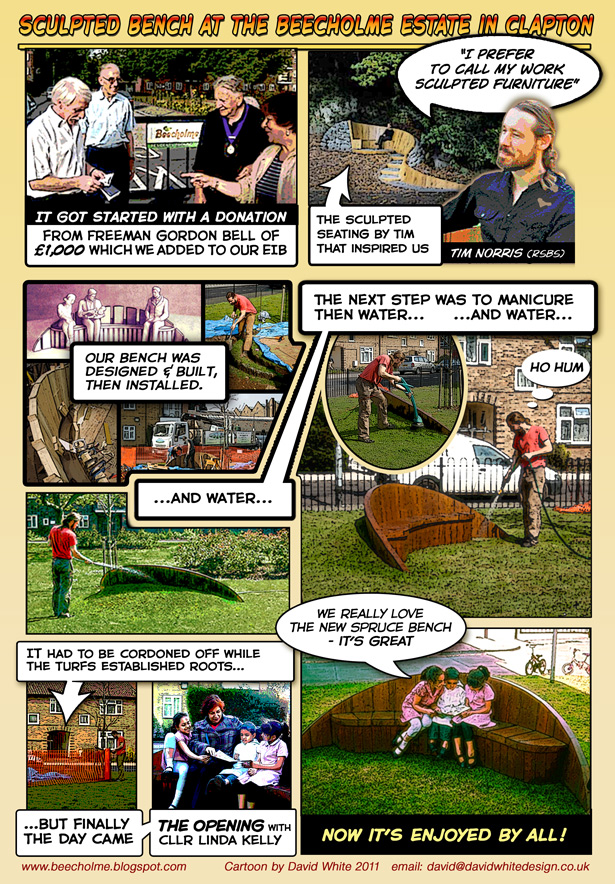
In addition, the two new sculpted benches will be in place by 31st March.

They are being done by Tim Norris, who did the first. He has designed them to match the first:


So this spring, with the wildflowers along the railing, the new benches in and everything else now done (like the pram shed doors), the estate should look better than ever.


Something to look forward to!


beecholme.tra@gmail.com


Thursday, 24 January 2013

Good start for new Clapton area Forum

NOTE: as always, please check back to see if I've updated any errors of fact.
Updated Thur 24th Jan.
 
The proposed new Neighbourhood Forum (Localism Act: planning) for the Clapton Pond and surrounds area got off to a great start at last night's public meeting in B6 College.


Right click on the panorama above & select "Open in new window" to see it full size (1,200 pixels)  Photo by David White.

The meeting was organised by the Clapton Arts Trust and Cazenove Architects in partnership with the Clapton Conference (a series of meetings set up by the Clapton Pond Neighbourhood Action Group to address planning issues locally). Councillor Linda Kelly chaired the meeting (as chair of the Clapton Arts Trust). 

Well over fifty people attended. 
Twenty nine local residents and representatives from local organisations & businesses signed up to become members of the new Forum, including Councillor Rick Muir, representing Hackney Downs ward.
Cllr Alex Russell (also Hackney Downs) was unable to attend but has indicated she will also sit on the Forum.

The participants will continue to work on the boundary at the at the inaugural meeting: date to be announced shortly and to be held in the near future - the Forum then named and constituted.

In due course the Forum will apply to the council to be the recognized forum for the area bounded.

Planning Aid for London will continue to offer support and guidance.

They will also facilitate workshop exercises, helping members decide a draft area boundary and distilling a set of "high level" or common aspirations for example.

The next meeting will be as widely advertised as possible but if you want get an email notification, you can subscribe to the Clapton Arts Trust "Clapton & Hackney wide News and Issues" mailing list.

The inaugural meeting is your opportunity to see what it's all about first hand - and of course, if you live locally or have a business in the area, you can join the Forum yourself.


• • •

The meeting at B6 on Wed 23rd Jan 2013
At the meeting Allison Borden from Planning Aid for London (pictured below) gave an overview of the new process and explained the requirements of the Localism Act with regard to Neighbourhood Forums and the wider planning landscape ie regional and local strategies.

View the PAL presentation online and download it here

PHOTO: Allison Borden of Planning Aid for London               Photo by David White

After the presentation and a short Q&A session, councillor Muir and (for the organisers) Louise Goodison, Dave Rindl and David White said a few words in explanation and/or support.
Everyone then moved next door for an introductory talk by Louise Goodison of Cazenove Architects (pictured below far left) about borders and the public realm. Louise then handed back to Allison from PAL, who facilitated an exercise to make a start setting the new Forum area draft boundary.

PHOTO: Louise Goodison of Cazenove Architects                 Photo by David White

If you want to join the Forum, come to the inaugural meeting - date to be announced shortly.

Subscribe to the Clapton Arts Trust "Clapton & Hackney wide News and Issues" mailing list to get notification.

Until the new Forum is constituted and named and has its own website and email, you can find background information about the Neighbourhood Forum on the "Vision for Clapton" page of the Clapton Arts Trust website.


Alternatively, view the "ClaptonVision 2013" page of the Beecholme blog.


-----------------------------------------------------------------


IMPORTANT NOTE:

If you live between Chatsworth Road and Lower Clapton Road, you should go to "Chatsworth Road Neighbourhood Plan" meetings too.


Tuesday, 15 January 2013

Sunday, 13 January 2013

TRA meeting 24 Jan


For all tenants, residents and leaseholders living on the Beecholme Estate or living in a Hackney Homes residence in Casimir, Cleveleys or Gunton Roads.


Contact the Beecholme & Casimir TRA at


Wednesday, 9 January 2013

Clapton Pond area: new Neighbourhood Forum public meeting


Please note - the following information is correct to the best of our knowledge - please check back to see if its been updated.

 The new Localism Act has placed local planning in the hands of local residents, via a "Forum" of at least 21 people.
   The first step is to agree the area boundary then form and name the Forum, which we hope to do at this meeting:


POSTER: David White.                                                                                        Email: david@davidwhitedesign.co.uk

This meeting is for everyone who lives in or has a business in Clapton Pond and the surrounding area*

*The idea is to mark out an area around Clapton Pond to take in both sides of Upper and Lower Clapton Roads (within Leabridge, Hackney Downs & Chatham), with Clapton Pond as the main "Town Centre", possibly to include the current conservation areas at the Pond, Clapton Square and Lea Bridge - see maps below


You'll have a chance to start setting the area boundary and name for the Forum at the meeting
 (with Planning Aid for London facilitating)

As the boundary for the Neighbourhood Forum has yet to be set, it's largely up to you whether your area is included or not.

You'll also have the opportunity to become a founding member of the Neighbourhood Forum at the meeting.


What is it all for? 
Through a consultation process and the formation of a Neighbourhood Plan or a series of individual planning documents, you can largely decide what gets built where, what it looks like, encourage developers to incorporate things you think important and stop things you think are inappropriate - and a lot more.

   Find out all about it - have your questions answered by Planning Aid for London at the meeting


Top to bottom: 
Lea Bridge, Clapton Pond & Clapton Square Conservation areas:


For more general and background information about the Neighbourhood Plan, see the Clapton Arts Trust Vision for Clapton page.


============


IMPORTANT NOTE:
There might be an overlap between the new Clapton Pond area Forum and the Chatworth Road Plan area.

If you live between Chatsworth Road & Lower Clapton Road
you should go to "Chatsworth Road Neighbourhood Plan" meetings as well.

The overlap may only affect the residences & businesses on the east side of Lower Clapton Road and the the Lea Bridge conservation area or it might affect nearly everyone between Lower Clapton Road and Chatsworth Road. We won't know until the end of the meeting what size (if any), the overlap might be.


The Chatsworth Road Neighbourhood Plan website


The Chatsworth Road Neighbourhood Plan area: